
Garden Arches
Catalog
Top sellers


-
Garden Arch PIA
£ 370.48 tax incl. Delivery time: 5 to 10 working daysThe Garden arch made of sturdy metal is available in sizes of 120 and 170 cm in the rust look, in the black and galvanised version -
Garden Arch BIANCA
£ 329.66 tax incl. Delivery time: 5 to 10 working daysThe Garden arch BIANCA is available in a width of 140 cm. -
Garden Arch MELANIE
£ 320.79 tax incl. Delivery time: 5 to 10 working daysThe Garden arch MELANIE is available in a width of 150 cm. -
Garden Arch ALEX Rounded top
£ 307.48 tax incl. Delivery time: 5 to 10 working daysThe Garden arch ALEX round, made of solid ferrous metal, gives front gardens a beautiful look. It is available in sizes from 120 cm to 260 cm, in a rust-look look and in a black or galvanised version. -
Garden Arch NINA
£ 317.24 tax incl. Delivery time: 5 to 10 working daysThe Garden arch NINA is available in a width of 120 cm. Three versions: Rust, black powder-coated or hot-dip galvanised. -
Garden Arch PETRA
£ 308.36 tax incl. Delivery time: 5 to 10 working daysThe Garden arch PETRA is available in a width of 140 cm. Three versions: Rust, black powder-coated or hot-dip galvanised. -
Garden Arch ELENA with Bench
£ 450.34 tax incl. Delivery time: 5 to 10 working daysThe Garden arch is made of square tube + wire and is available in a width of 130 cm. -
Garden Arch SABINE
£ 760.94 tax incl. Delivery time: 5 to 10 working daysHigh-quality Garden arch SABINE made of iron with two integrated planters - sturdy, weatherproof and available in rust, black or hot-dip galvanised. -
Garden Arch JULIAN
£ 1,204.63 tax incl. Delivery time: 5 to 10 working daysThe most solid Garden arch JULIAN in the collection: 64 kg weight, 150 cm wide, made of robust iron. Available in rust, black or hot-dip galvanised.


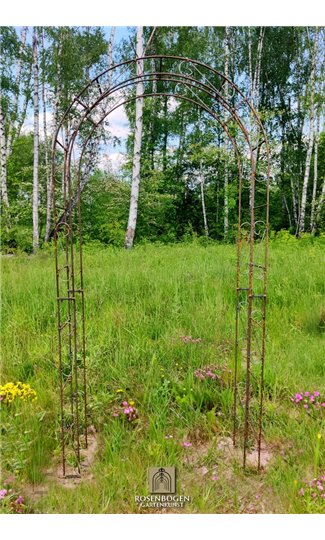
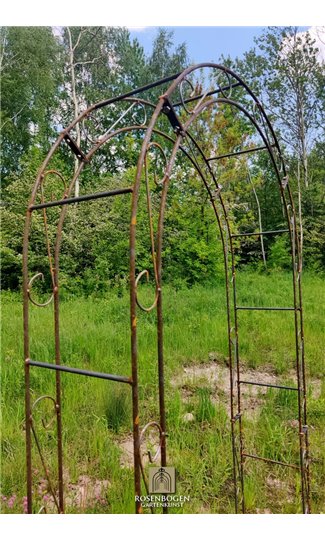


Metal Garden Arches – heavy-duty arches for roses and climbers
A garden arch marks the point where one part of the garden ends and another begins – the entrance to a path, the gap between two borders, the way through to a seating area. To do that job for twenty years it has to carry two things: the weight of a mature climbing rose, and the wind pushing against it once the foliage closes up. That is why even our lightest standard arch weighs over 20 kilograms – solid iron, reinforced with flat bar, made by hand in our own workshop.
Three finishes – and one for the coast
Rust finish: the steel develops an even patina that protects the structure and darkens with age. It suits cottage gardens, wildflower planting and old brickwork; run-off can stain light paving in the first months, which on lawn or border does not matter.
Black powder-coated: a matt, closed surface that lets the frame recede so the planting is what you see – the usual choice for formal and contemporary gardens.
Hot-dip galvanised: the zinc is applied by immersion, protecting cut edges and welds as well as the surface. It is the finish we recommend for coastal gardens and anywhere the ground stays wet – which, across much of Britain, is a fair description of winter. Our PREMIUM range combines both: galvanised first, then powder-coated in the colour of your choice.
Choosing the right width
Our garden arches come in widths from 120 to 260 cm, with the popular models at 120, 140 and 170 cm. They stand 231 cm tall with a clear walk-through height of 225 cm, and the uprights can be raised a further 40 or 50 cm with our extension pieces. Measure your path, then allow for the planting: an established climbing rose takes up 20 to 30 cm on each side – and that growth is what brushes your shoulders every time you walk through. As a guide, 120–140 cm suits a narrow path, 160–180 cm two people side by side or a wheelbarrow, and 200 cm upwards frames driveways and walkways.
Anchoring – and why British weather makes it non-negotiable
In soft ground the uprights are secured with our 41 cm ground anchors – two per side. On a patio or concrete base, the upright bolts down through the pre-drilled holes; for setting in concrete we make dedicated concrete anchors. Base fixings are not included, as they must match the surface you are fixing into.
An arch that simply stands on the lawn will survive its first summer. Once the planting forms a solid face it behaves like a sail, and a winter gale will find it – which is why we treat anchoring as part of the structure, not an accessory.
What to grow over it
Climbing roses are the traditional choice. New Dawn is reliable in sun, repeat-flowering and lightly scented; Zephirine Drouhin tolerates part shade and is thornless – worth a great deal on a doorway you use daily. Clematis grows happily through roses and shades their roots; honeysuckle adds evening scent. Wisteria is possible, but only on a substantial frame – a mature plant generates enough force over the years to fold a lightweight arch, while a solid one will carry it for decades.
Plant one climber each side, 30 to 40 cm out from the base and angled towards the arch. Tie in new growth loosely for the first two seasons; after that the plant finds its own way.
Assembly: six parts, no special tools
Each arch consists of four side sections and two roof sections, with the connecting bolts supplied. Illustrated assembly instructions are available in our Service section, and if anything is unclear a photo of the site sent by email or WhatsApp is usually the fastest route to an answer.
Wooden or metal garden arch?
A wooden garden arch looks warm from day one and costs less to buy – and for light planting or a garden that changes every few years it is a perfectly good choice. Its weak point is where it meets the ground: timber in permanently damp soil rots from the base, and re-staining an arch that a rose has already claimed is a job nobody does twice. A heavy-duty metal arch turns that maths around: more to buy, nothing to maintain, and with a galvanised finish the ground-contact problem simply disappears. Over twenty years the metal arch is usually the cheaper one – and the rose never has to move house.
From a single arch to a garden feature
The walk-through arch is only the beginning. A garden arch with a gate turns a gap in the hedge into a proper entrance; an arch with a bench is a ready-made arbour for a quiet corner; a wall arch frames a front door; and several arches in a row become a garden archway – a green tunnel that makes even a short path feel like a walk. All variants share the same finishes, so the pieces work together as one design.
Made to measure
If none of the standard widths fits, we make arches to your dimensions – width, height and finish to order. Send us your measurements and you will receive a quotation with a drawing.
Delivery and payment
We ship by UPS with full tracking; delivery typically takes 5–10 business days because of the size of the products. Delivery within the United Kingdom is free, and all duties and taxes are included – there are no hidden fees at the door.
Frequently asked questions
How tall is a garden arch?
Ours stand 231 cm tall with a 225 cm walk-through, and can be raised a further 40–50 cm with extension pieces.
How do you secure a metal garden arch in the ground?
The 41 cm ground anchors hold securely in undisturbed soil, with no concrete needed; in sand or made-up ground, add a small concrete pad or use our concrete anchors.
Which metal garden arch lasts longest?
The hot-dip galvanised finish – the zinc protects the section in the ground, where other materials fail first. The PREMIUM range, galvanised and then powder-coated, lasts longest of all.
Will a rust-finish arch rust through?
No. The patina forms a closed protective layer; at the material thickness we use, the loss over the arch's lifetime is not structurally relevant.
Which rose suits a 140 cm arch?
A repeat-flowering climber reaching 250–350 cm – New Dawn, for example. Ramblers reach six metres and more; they need a walkway or an old tree, not a single arch.